 John
Cowan -
John
Cowan -
(Observations of Supernovae, External Galaxies and Black Holes)
- Current paper in postscript format DISCOVERY OF A NUCLEAR X-RAY SOURCE IN NGC 7331: EVIDENCE FOR A MASSIVE BLACK HOLE ApJ Letters 508, L33 (1998)
- Current paper in postscript format THE PROBABLE DETECTION OF SN 1923A: THE OLDEST RADIO SUPERNOVA? ApJ, 508, 664 (1998)
- Current paper in postscript format THE FADING RADIO EMISSION FROM SN 1961V: EVIDENCE FOR A TYPE II PECULIAR SUPERNOVA? , astro-ph/0104235, AJ, 122, 283 (2001)
- Current paper in postscript format THE CONTINUING RADIO EVOLUTION OF SUPERNOVA 1970G, astro-ph/0108262, ApJ Letters, 559, L139 (2001)
- Current paper in postscript format THE A SEARCH FOR RADIO EMISSION FROM SUPERNOVAE WITH AGES FROM ABOUT ONE WEEK TO MORE THAN 80 YEARS, astro-ph/0204466, ApJ, 573, 306 (2002)
- Current paper in pdf format THE NATURE OF SN 1961V, astro-ph/0402473, Astron. J., 127, 2850 (2004)
- Current paper in pdf format PRELIMINARY RADIO ANALYSIS FROM AN X-RAY/RADIO SURVEY OF NEARBY SPIRAL GALAXIES, in ``X-Ray and Radio Connections'', eds. Sjouwerman, L.O.& Dyer, K.K., http://www.aoc.nrao.edu/events/xraydio (2005)
- Current paper in pdf format A RADIO AND X-RAY STUDY OF HISTORICAL SUPERNOVAE IN M83, astro-ph/0511202, Astron. J., 131, 889 (2006)
- Current paper in pdf format A STUDY OF COMPACT RADIO SOURCES IN NEARBY FACE-ON SPIRAL GALAXIES. I. LONG TERM EVOLUTION OF M83 astro-ph/0603850, Astron. J., 132, 310 (2006) Radio Image of M83
- Current paper in pdf format A STUDY OF COMPACT RADIO SOURCES IN NEARBY FACE-ON SPIRAL GALAXIES. II. MULTIWAVELENGTH ANALYSES OF SOURCES IN M51, astro-ph/0702310, Astron. J., 133, 2559 (2007) The Cover of the Astronomical Journal, June 2007,
- Current paper in postscript format R-PROCESS IN COLLAPSING O/NE/MG CORES ApJ Letters, 493, L101 (1998)
- Current paper in postscript format HST OBSERVATIONS OF NEUTRON-CAPTURE ELEMENTS IN VERY METAL-POOR STARS ApJ, 496, 235 (1998)
- Current paper in postscript format STELLAR ABUNDANCE OBSERVATIONS in Stellar Evolution, Stellar Explosions and Galactic Chemical Evolution, ed. A. Metzacappa (Bristol: Institute of Physics), 621 (1998)
- Current paper in postscript format GHRS OBSERVATIONS OF NEUTRON-CAPTURE ELEMENTS IN METAL-POOR HALO STARS In ASP Conf. Ser., The Scientific Impact of the Goddard High-Resolution Spectrograph, ed. J. C. Brandt, T. B. Ake, & C. C. Peterson (San Francisco: ASP), 350 (1998)
- Current paper in postscript format ``SUPERNOVA BIRTH FOR A BLACK HOLE,'' Nature: News and Views, 401, 124 (September 9, 1999)
- Current paper in postscript format R-PROCESS ABUNDANCES AND CHRONOMETERS IN METAL-POOR STARS ApJ, 521, 194 (1999)
- Current paper in postscript format NEUTRON CAPTURE NUCLEOSYNTHESIS IN EARLY GALACTIC ENVIRONMENTS in The First Stars, eds. A. Weiss, T. Abel and V. Hill (Berlin: Springer ), 142 (2000)
- Current paper in postscript format EVIDENCE OF MULTIPLE R-PROCESS SITES IN THE EARLY GALAXY: NEW OBSERVATIONS OF CS 22892-052, ApJ, 533, L139 (2000)
- Current paper in postscript format THE R-PROCESS-ENRICHED LOW METALLICITY GIANT HD 115444 ApJ, 530, 783 (2000)
- Current paper in postscript format ABUNDANCES AND AGES IN HALO STARS, in The Tenth Workshop on Nuclear Astrophysics, eds. W. Hillebrandt and E. Muller (Munich: MPI), 64 (2000)
- Current paper in postscript format ON THE SITE OF THE WEAK R-PROCESS COMPONENT, in The Tenth Workshop on Nuclear Astrophysics, eds. W. Hillebrandt and E. Muller (Munich: MPI), 68 (2000)
- Current paper in postscript format NEUTRON CAPTURE ELEMENT ABUNDANCES IN THE GLOBULAR CLUSTER M15, ApJ, 536, L85 (2000)
- Current paper in postscript format NEUTRON-CAPTURE ELEMENTS IN THE EARLY GALAXY: INSIGHTS FROM A LARGE SAMPLE OF METAL-POOR GIANTS, ApJ, 544, 302 (2000)
- Current paper in postscript format THE AGE OF THE GALAXY FROM THORIUM COSMOCHRONOMETRY, astro-ph/0008185, in The Seventh Texas-Mexico Conference on Astrophysics: Flows, Blows and Glows, Revista Mexicana de Astronomia y Astrofisica, Serie de Conferencias, ed. William Lee and Silvia Torres-Peimbert, 221 (2001)
- Current paper in postscript format NUCLEAR CHRONOMETERS, astro-ph/0101438, in Cosmic Evolution, ed. E. Vangioni-Flam, R. Ferlet and M. Lemoine, (Singapore: World Scientific Publishing), 189 (2001)
- Current paper in postscript format NEUTRON-CAPTURE ELEMENT TRENDS IN THE HALO, astro-ph/0101439, in Cosmic Evolution, ed. E. Vangioni-Flam, R. Ferlet and M. Lemoine, (Singapore: World Scientific Publishing), 179 (2001)
- Current paper in postscript format HALO STAR ABUNDANCES AND R-PROCESS SYNTHESIS, astro-ph/0101440, Nuclear Physics A, 688, 330c (2001)
- Current paper in postscript format THE EARLY FORMATION, EVOLUTION AND AGE OF THE NEUTRON-CAPTURE ELEMENTS IN THE EARLY GALAXY, astro-ph/0103222, in Relativistic Astrophysics: 20th Texas Symposium, eds. C. Wheeler & H. Martel (New York: American Institute of Physics), 337 (2001)
- Current paper in postscript format NEUTRON-CAPTURE ELEMENT ABUNDANCES AND COSMOCHRONOMETRY, astro-ph/0106366, in Astrophysical Ages and Time Scales, eds. T. von Hippel, C. Simpson & N. Manset (San Francisco: ASP), 235, (2001)
- Current paper in postscript format NUCLEOSYNTHESIS CLOCKS AND THE AGE OF THE GALAXY, astro-ph/0109526, in Astrophysical Ages and Time Scales, eds. T. von Hippel, C. Simpson & N. Manset (San Francisco: ASP), 226, (2001)
- Current paper in postscript format GALACTIC COSMOCHRONOMETRY FROM RADIOACTIVE ELEMENTS IN THE SPECTRA OF VERY OLD METAL-POOR STARS, astro-ph/0109194,Physica Scripta, T100, 15 (2002)
- Current paper in postscript format A SIMPLE MODEL FOR r-PROCESS SCATTER AND HALO EVOLUTION, astro-ph/0103083, ApJ, 575, 845 (2002)
- Current paper in postscript format EUROPIUM ISOTOPIC ABUNDANCES IN VERY METAL-POOR STARS, astro-ph/0201456, ApJ Letters, 566, L25 (2002)
- Current paper in pdf format THE CHEMICAL COMPOSITION AND AGE OF THE METAL-POOR HALO STAR BD +17^\circ 3248, astro-ph/0202429, ApJ, 572, 861 (2002)
- Current paper in postscript format THE R-PROCESS AND CHRONOMETERS, astro-ph/0204294, in The Eleventh Workshop on Nuclear Astrophysics, eds. W. Hillebrandt and E. Muller (Munich: MPI), 176 (2002)
- Current paper in pdf format THORIUM AND URANIUM CHRONOMETERS APPLIED TO CS 31082-001, ApJ, 579, 626 (2002)
-
Pdf version with color figures: The Extremely Metal-Poor, Neutron-Capture Rich Star CS 22892--052: A Comprehensive Abundance Analysis, astro-ph/0303542, Astrophys. J., 591, 936 (2003).
-
Pdf version with color figures: Binary Blue Metal-Poor Stars: Evidence for AGB Mass Transfer, astro-ph/0304064, Astrophys. J., 592, 504 (2003).
-
Pdf version : Elements of Surprise , Nature: News and Views, 423, 29 (May 4, 2003).
More papers in 2003:
-
Pdf version : Galactic Evolution of Sr, Y and Zr: A Multiplicty of Nucleosynthetic Processes, Astrophys. J., 601, 864, (2004).
-
Pdf version : Improved Atomic Data for Ho II and New Holmium Abundances for the Sun and Three Metal-Poor Stars, Astrophys. J., 604, 850 (2004).
-
Pdf version : A Sprinkling of Stardust, Nature, 428, 369 (2004).
-
Pdf version : Stellar Abundances: The r-Process and Supernovae, in 3-D Signatures in Stellar Explosions, ed. P. Kumar, C. Wheeler & P. Hoeflich (Cambridge: Cambridge Univ. Press), 255 (2004).
-
Pdf version : Halo Star Abundances and Heavy Element Nucleosynthesis, astro-ph/0405423, in the Proceedings of the 12th Workshop on Nuclear Astrophysics, eds. E. Muller and H. Thomas Janka (Munich: MPI ), 41 (2004).
-
Pdf version : The rise of the s-Process in the Galaxy, ApJ, 617, 1091 (2004).
2005:
-
Pdf version : HST Observations of Heavy Elements in Metal-Poor Galactic Halo Stars, astro-ph/0502591, Astrophys. J., 627, 238 (2005).
-
Pdf version : Neutron-Capture Element Abundances in Halo Stars, astro-ph/0409552, in ASP Conf. Ser., Cosmic Abundances as Records of Stellar Evolution and Nucleosynthesis ed. T. Barnes and F. Bash (San Francisco: ASP), 313 (2005).
-
Pdf version : Near-UV Observations of CS2947-030: New Constraints on Neutron-Capture Nucleosynthesis Processes, astro-ph/0505002, Astrophys. J., 627, L145 (2005).
-
Pdf version : Improved Laboratory Transition Probabilities for Pt I and Application to the Platiunum Abundances of BD +17 3248 and the Sun, Astrophys. J., 619, 639 (2005).
2006:
-
Pdf version : Sm Transition Probabilities and Abundances,'' astro-ph/0510585, Astrophys. J. Supp., 162, 227 (2006).
-
Pdf version : Near-UV Observations of HD221170: New Insights into the Nature of r-Process-Rich Stars, astro-ph/0604180, Astrophys. J., 645, 613 (2006).
-
Pdf version : Nucleosynthesis: Stellar and Solar Abundances and Atomic Data, astro-ph/0605137, in the Proceedings of the NASA Laboratory Astrophysics Workshop (2006).
-
Pdf version : Gd Transition Probabilities and Abundances, astro-ph/0609487, Astrohys. J. Supp., 167, 292 (2006).
-
Pdf version : In Memory of Al Cameron, arXiv:astro-ph/0611824, http://indico.cern.ch/conferenceTimeTable.py?confId=059, in Nuclei in the Cosmos-IX, 205 (2006)
-
Pdf version : r-Process Enhanced Halo Stars, arXiv:astro-ph/0610412, http://indico.cern.ch/conferenceTimeTable. py?confId=059, in Nuclei in the Cosmos-IX, 14 (2006)
2007:
-
Pdf version : Hf Transition Probabilities and Abundances, astro-ph/0611036, Astrophys. J. Supp., 169, 120 (2007).
-
Pdf version : Explorations of the r-Processes: Comparisons between Calculations and Observations of Low-Metallicity Stars, astro-ph/0703091, Astrophys. J., 662, 39 (2007).
-
Pdf version : Nucleosynthesis in the Early Galaxy, Astrophys. J., 671, 1685 (2007).
2008:
-
Pdf version : Abundance Signatures in Halo Stars, in First Stars III (2008)
-
Pdf version : Nucleosynthesis Modes in the High-Entropy-Wind Scenario of Type II Supernovae, in First Stars III (2008)
-
Pdf version : Europium, Samarium, and Neodymium Isotopic Fractions in Metal-Poor Stars, in First Stars III (2008)
-
Pdf version : Europium, Samarium and Neodymium Isotopic Fractions in Metal-Poor Stars, astro-ph/0712.2473, Astrophys. J., 675, 723 (2008).
-
Pdf version : The Hobby-Eberly Telescope "Chemical Abundances of Stars in the Halo" (CASH) Project. I. The Lithium-, s-, and r-Enhanced Metal-Poor Giant HKII 17435-00532, arXiv:0802.3701, Astrophys. J., 679, 1549 (2008).
-
Pdf version : Er II Transition Probabilities and Abundances arXiv:0804.4465, Astrophys. J. Supp., 178, 71 (2008).
2009:
-
Pdf version : Nucleosynthesis Modes in the High-Entropy-Wind of Type II Supernovae: Comparison of Calculations with Halo-Star Observations, arXiv:0901.2541, ApJ Letters, 694, L49 (2009)
Pdf version : Improved Laboratory Transition Probabilities for Ce II, Application to the Cerium Abunandances of the Sun and Five r-process rich, Metal-poor Stars, and Rare Earth Lab Data Summary, arXiv:0903.1982, ApJ Supplement, 182, 51 (2009)
Pdf version : New Rare Earth Element Abundance Distributions for the Sun and Five r-Process-Rich Very Metal-Poor Stars, arXiv:0903.1623, ApJ Supplement, 182, 80 (2009)
Pdf version : The End of Nucleosynthesis: Production of Lead and Thorium in the Early Galaxy, arXiv:0904.3105, ApJ 698, 1963 (2009)
2010:
-
Pdf version : Empirically Derived Integrated Stellar Yields of Fe-Peak Elements, arXiv:0912.1816, ApJ, 709, 715 (2010)
-
Pdf version : New Abudance Determinations of Cadmium, Lutetium and Osmium in the r-Process Enriched Star BD +17 3248, arXiv:1003.4522, ApJ Letters, 714, L123 (2010)
-
Pdf version : The Ubiquity of the Rapid-Neutron Capture Process, arXiv:1009.4496, Ap J., 724, 975 (2010)
2011:
-
Pdf version : r-Process Abundance Signatures in Metal-Poor Halo Stars, arXiv:1106.1109, RR Lyrae Stars, Metal-Poor Stars, and the Galaxy, Carnegie Observatories :Astrophysics Series, Vol. 5. Edited by Andrew McWilliam. Pasadena, CA: The Observatories of the Carnegie Institution of Washington, 2011., p.223 (2011)
-
Pdf version : Improved log(gf ) Values of Selected Lines in Mn I and Mn II for Abundance Determinations in FGK Dwarfs and Giants, ApJS, 194, 35 (2011)
-
Pdf version : The Abundances of Neutron-capture Species in the Very Metal-poor Globular Cluster M15: A Uniform Analysis of Red Giant Branch and Red Horizontal Branch Stars, arXiv:1103.1008, AJ, 141, 175 (2011)
2012:
-
Pdf version : Detection of the Second r-Process Peak Element Tellurium in Metal-Poor Stars, arXiv:1202.2378, ApJ, 747, L8 (2012)
-
Pdf version : New Hubble Space Telescope Observations of Heavy Elements in Four Metal-Poor Halo Stars, arXiv:1210.6387, ApJS, 203, 27 (2012)
2013:
-
Pdf version : IMPROVED Ti ii log(gf) VALUES AND ABUNDANCE DETERMINATIONS IN THE PHOTOSPHERES OF THE SUN AND METAL-POOR STAR HD 84937, ApJS, 208, 27 (2013)
-
Pdf version : IMPROVED log(gf) VALUES FOR LINES OF Ti i AND ABUNDANCE DETERMINATIONS IN THE PHOTOSPHERES OF THE SUN AND METAL-POOR STAR HD 84937 (ACCURATE TRANSITION PROBABILITIES FOR Ti , arXiv:1210.6387, ApJS, 205, 11 (2013)
2014:
-
Pdf version : IMPROVED Ni i log(gf ) VALUES AND ABUNDANCE DETERMINATIONS IN THE PHOTOSPHERES OF THE SUN AND METAL-POOR STAR HD 84937, arXiv:1402.4457, ApJS, 211, 20 (2014)
-
Pdf version : NEW DETECTIONS OF ARSENIC, SELENIUM, AND OTHER HEAVY ELEMENTS IN TWO METAL-POOR STARS, arXiv:1406.4554, ApJ, 791, 32 (2014)
-
Pdf version : HUBBLE SPACE TELESCOPE NEAR-ULTRAVIOLET SPECTROSCOPY OF THE BRIGHT CEMP-NO STAR BD+44 493, arXiv:1406.0538, ApJ, 790, 34 (2014)
-
Pdf version : Improved V II log(gf) Values, Hyperfine Structure Constants, and Abundance Determinations in the Photospheres of the Sun and Metal-poor Star HD 84937, STAR BD+44 493, arXiv:1408.4175, ApJS, 214, 18 (2014)
-
Pdf version : Nine new metal-poor stars on the subgiant and red horizontal branches with high levels of r-process enhancement, arXiv:1409.5810, MNRAS, 445, 2970 (2014)
Recent Reviews, Essays and Journal Article Reviews:
-
Postscript manuscript with color figures: Probing the Neutron-Capture Nucleosynthesis History of the Early Galaxy astro-ph/0209308, PASP, 114, 1293 (2002).
-
Pdf journal version with black and white figures: Probing the Neutron-Capture Nucleosynthesis History of the Early Galaxy astro-ph/0209308, PASP, 114, 1293 (2002).
-
Pdf manuscript with color figures: The Genesis of the Heaviest Elements in the Milky Way Galaxy Science, 299, 70 (2003).
-
Pdf manuscript with color figures: Advances in r-Process Nucleosynthesis in Carnegie Observatories Astrophysics Series, Vol. 4: Origin and Evolution of the Elements, ed. A. McWilliam & M. Rauch (Cambridge: Cambridge Univ. Press), 27 (2004)
-
Pdf manuscript with color figures: R-Process Nucleosynthesis in Supernovae Physics Today, Volume 57 Number 10, 47 (October, 2004). Copyright (2004) American Institute of Physics. This article may be downloaded for personal use only. Any other use requires prior permission of the author and the American Institute of Physics. Website link to Physics Today
-
Pdf manuscript with color figures: Heavy Element Synthesis in the Oldest Stars and the Early Universe Nature, Volume 440, 1151 (April 27, 2006). This article may be downloaded for personal use only. Any other use requires prior permission of the author and Nature Publishing Group. Website link to Nature
-
Pdf article: Journal Club: An astronomer invites you to contemplate the history of the some of the oldest stars in the Universe. Nature, Volume 440, 129 (January 11, 2007). This article may be downloaded for personal use only. Any other use requires prior permission of the author and Nature Publishing Group. Website link to Nature
-
Pdf article: Essay in Concepts: A Constant Surprise Nature, Volume 448, 29 (July 5, 2007). This article may be downloaded for personal use only. Any other use requires prior permission of the author and Nature Publishing Group. Website link to Nature
-
Neutron Capture Elements in the Early Galaxy Annual Reviews of Astronomy and Astrophysics, 46, 241-288 (2008) // URL link to Annual Reviews I am pleased to provide you complimentary one-time access to my Annual Reviews article as a PDF file (URL Link), for your own personal use. Any further/multiple distribution, publication, or commercial usage of this copyrighted material requires submission of a permission request addressed to the Annual Reviews Permissions Department, email permissions@AnnualReviews.org.
- Website link to astro-ph preprints
- Most of my publications as listed on ADS
-
Pdf version of power point talk: ``Probing the Nucleosynthesis Products of the First Stars,'' Meeting on the Chemical Enrichment of the Early Universe, Santa Fe, NM (2004).
-
Pdf version of power point talk: ``Stellar Abundance Observations and the R-Process,'' JINA Workshop on the Discussion of the R-Process, Notre Dame, IN (2005).
-
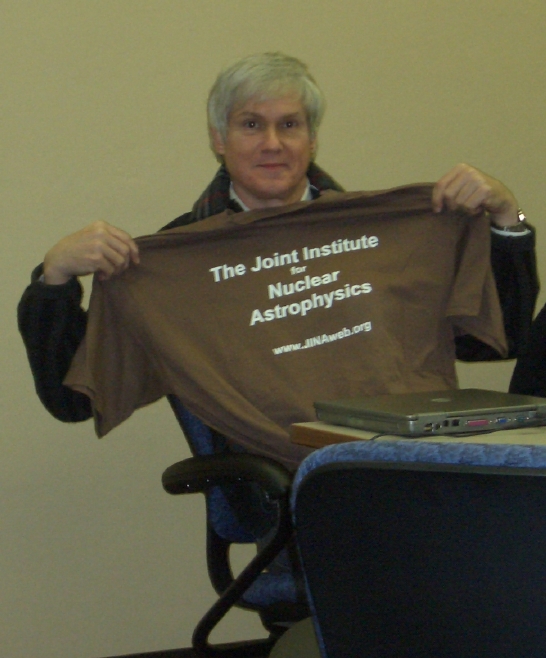
Working hard at the JINA meeting:
-
Pdf version of power point talk: ``R-Process Signatures in Halo Stars, '' 2nd Vistars Workshop, Russbach, Austria (2005).
-
Pdf version of power point talk: ``Stellar Abundance Observations and Heavy Element Formation, '' Invited Talk, AAS Meeting, Minneapolis, MN (2005).
-
Pdf version of power point talk: ``The Age of the Oldest Stars as a Constraint on Cosmological Models,'' Meeting on Outstanding Questions for the Standard Cosmological Model, London, England (2007).
-
Power point talk: ``Nucleosynthesis, the r-Process, Abundances and Jim Truran,'' JINA Frontiers 2010: Workshop on Nuclear Astrophysics, Lake Geneva, WI (2010).
-
Pdf version of Power point talk: ``Stellar Abundances, Heavy Element Formation and the Age of the Galaxy,'' Invited Colloquium, Basel Switzerland (2011).
Recent Video Interview with the OU Daily:
-
``Five Minutes with Dr. Cowan - A Star is Born
''
Recent Article in the OU Daily:
-
``Professor Goes the Distance to Find Gold''
Summary of National Science Foundation-Supported Research Activities:
-
``Annual Project Report''
Figures and Transparencies:
- Color Figure in postscript format Figure 2 from Sneden et al. (2000)
- Color Figure in postcript format Total Abundances in CS 22892-052
- Color Figure in postcript format Total Abundance Figure:
- Color Figure in postscript format r-Process Abundances in Halo Stars
- Color Figure in postcript format r-Process Abundances in BD+17 3248
- Color Figure in postscript format r-Process Abundances in BD+17 3248 With Model SS Fit
- Color Figure in postscript format Solar System Isotopic Breakdown after Cowan & Thielemann 2004, Physics Today
- Color Figure in jpeg format Solar System Isotopic Breakdown after Cowan & Thielemann 2004, Physics Today
- Color Figure in postscript format Chart of the Nuclides after Sneden & Cowan 2003, Science (with thanks to Peter Moeller)
- Color Figure in jpeg format Chart of the Nuclides after Sneden & Cowan 2003, Science (with thanks to Peter Moeller)
- Color Figure in pdf format Figure 2. A portion of the nuclear chart showing elements Xe to Pr and the production of each isotope by the p- s- and r-processes. The s-process (turquoise line) operates close to stability - the black boxes show stable nuclei - while the r-process is formed out of very neutron-rich (unstable) nuclei that beta decay back (green lines) to stability. We also add one isotope of Nd to this chart to indicate the next steps in the s-process chain, but do not indicate the other Nd isotopes. Listed to the outside right are the total percentage breakdowns by process for each element.
- Color Figure in pdf format Figure 3. The total solar-system abundances by mass number based upon the Si=10^6 (meteoritic) scale. Comparisons is made between the early work of Cameron (1959) (filled circles) and the more recent compilation by Lodders (2003) (solid line).
- Color Figure in pdf format Figure 4. Spectra of the r-process-rich star CS 22892-052 (blue line) contrasted with spectra of the neutron-capture-deficient star HD 122563. In the top panel, relatively low-resolution (R~$\sim$ 2500) spectra from the Rossi et al. (2005) survey, covering most of the standard stellar classification wavelength region, are displayed. The carbon-richness ([C/Fe] ~ +1) of CS 22892-052 is apparent in its CH band strength. An expanded view of a smaller portion of these spectra is shown in the middle panel. High-resolution spectra of an even narrower wavelength region are shown in the bottom panel. The data for CS 22892-052 and HD 122563 are those of Sneden et al. (2003) and Westin et al. (2000), respectively.
- Color Figure in pdf format Figure 6. Left-hand panel: abundances of meteorites (Lodders 2003), CS 22892-052 (Sneden et al. 2003b), HD 115444 (Westin et al. 2000), and BD+17 3248 (Cowan et al. 2002) minus solar-system r-process abundances (Simmerer et al. 2004), with abundance differences normalized to zero at Eu. Right-hand panel: corrected abundance differences for the three r-process-rich stars and the solar photosphere after application of recent laboratory transition probabilities (Lawler et al. 2007, and references therein). This figure is an update of Figure 5 of Den Hartog et al. 2006, in which a more detailed description of the figure can be found.
- Color Figure in pdf format Figure 10. Comparison of CS 22892-052 Z>=56 abundances with solar-system s- (green dashed line) and r-process (solid blue lines) only elemental abundance distributions. The CS 22892-052 data are from Sneden et al. with revised values for Nd (Den Hartog et al. 2003), Ho (Lawler, Sneden & Cowan 2004), Gd (Den Hartog et al. 2006), Sm (Lawler et al. 2006), and Hf (Lawler et al. 2007). The solar-system curves are from Simmerer et al. (2004) as updated by Cowan et al. (2006). These curves have been normalized as follows: the s-process-only curve (green dashed line) to the CS 22892-052 Ba abundance and the r-process-only (blue solid line) to the CS 22892-052 Eu abundance.
- Color Figure in pdf format Figure 11. Top panel: Comparisons of n-capture abundances in six r-process-rich Galactic halo stars with the solar-system r-only abundance distribution. Starting from the top of the upper panel, the stars are CS 22892-052 (red circles, Sneden et al. 2003), HD 115444 (green squares, Westin et al. 2000), bd+17 3248 (purple diamonds, Cowan et al. 2002), CS 31082-001 (black stars, Hill et al. 2002), HD 221170 (turquoise right-facing triangles, Ivans et al. 2006) and HE 1523-0901 (orange left-facing triangles, Frebel et al. 2007). The abundance data of all stars except CS 22892-052 have been vertically displaced downward for display purposes. The solid blue lines are the scaled r-only solar system elemental abundance curves (Simmerer et al. 2004; Cowan et al. 2006), normalized to the Eu abundance of each star. Middle panel: difference plot showing the individual elemental abundance offsets, with abundance differences normalized to zero at Eu for each of the six stars with respect to the solar-system r-process-only abundances. Zero offset is indicated by the dashed horizontal line. Symbols for the stars are the same as in the top panel. Bottom panel: average stellar abundance offsets. For individual stars all elemental abundances were first scaled to their Eu values, then averaged for all six stars, and finally compared to the solar-system r-only distribution.
- Color Figure in pdf format Figure 12. Abundance comparisons log epsilon(La/Eu) (top panel) and log epsilon(Hf/Eu) (bottom panel) versus metallicity, [Fe/H], for a group of 10 metal-poor, r-process-rich stars after Lawler et al. 2007. The solid line is the mean ratio of the 10 halo stars, the dashed line is the predicted total solar system, and the dotted lines indicate the predicted solar-system r-process-only values for these ratios.
- Color Figure in pdf format Figure 14. [Mg/Fe] and [Eu/Fe] abundances as a function of [Fe/H] metallicity for halo and disk stars. For this figure the data have been taken only from large-sample surveys: Barklem et al. (2005), Cayrel et al. (2004), Cohen et al. (2004), Fran\c{c}ois et al. (2007), Fulbright (2000), Reddy, Lambert, & Allende Prieto (2006), Reddy et al. (2003), Simmerer et al. (2004). In both panels the dotted lines represent the solar abundance ratios. In the lower panel, the solid line is a least-square fit to the Eu data, and the two dashed lines indicate the approximate extent of the Eu/Fe data (similar to Cowan & Thielemann 2004).
- Color Figure in pdf format Figure 15. [Ge/H] abundances in a sample of 11 Galactic halo stars as a function of metallicity. The arrow denotes the upper limit for CS 22892-052. The dashed line represents the solar abundance ratio of these elements, [Ge/H] = [Fe/H], and the solid green line shows the derived correlation, [Ge/H] = [Fe/H] - 0.79, for all the stars, after Cowan et al. 2005.
- Color Figure in pdf format Figure 16. Abundance trends with respect to metallicity for the elemental ratio La/Eu in a large number of stars in our Galaxy (after Simmerer et al. 2004). The filled blue circles are halo stars and the filled red diamonds are disk stars. The (green) right facing triangles are from Barklem et al. (2005). The r-process-only ratios predicted for La/Eu in various literature sources are shown with black lines. They are (from bottom to top): Burris et al. (2000) (dotted line), O'Brien et al. (2003) (short dashed line), Terlizzi et al. 2007 (dot-dashed line), and Winckler et al. (2006) (long dashed line). The solid purple line is the average stellar abundances based upon Lawler et al. (2007) and Figure 12. The black solid line is the total Solar System abundance. The pink boxes are well studied r-process-rich stars, including CS 22892-052, HD 115444, CS~31082-001 and bd+17 3248.
- Color Figure in pdf format Figure 8. Comparison of the newly derived RE abundances in five r-rich halo stars with predictions for solar system r-process only abundances from Arlandini etal (1999) and Simmerer etal (2004). For each star the abundances have been normalized at Eu. (Sneden et al. 2009)
- Color Figure in pdf format Figure 9. Comparison of the newly derived RE abundances in five r-rich halo stars to the solar system r-process only value from Arlandini etal (1999). For each star the abundances have been normalized at Eu. The dotted line indicates a perfect agreement between the stellar and solar system r-only values. (Sneden et al. 2009).
- Color Figure in pdf format Figure 10. Comparison of the newly derived RE abundances in five r-rich halo stars to the solar system r-process only value from Arlandini etal (1999) as a function of percentage of the solar system elemental s-process. The dashed line indicates a perfect agreement between the stellar and solar system r-only values. For clarity in this figure, a different color has been used for each element. (Sneden et al. 2009).
- Color Figure in pdf format Figure 11. Averages of the stellar elemental abundance offsets of the five stars with respect to the solar system r-process only value from Arlandini etal (1999) as a function of percentage of the solar system elemental s-process. For each star included in the average the abundance offsets have been normalized at Eu. The dotted line indicates a perfect agreement between the average stellar and solar system r-only values.
(Abundances, Nucleosynthesis, Stellar Evolution and Ages)
1998:
1999:
2000:
2001:
2002:
BD +17 3248 Recent Results:
Poster and Press Release from Washington AAS Meeting.
2003:
2004:
Pdf manuscript with color figures: The Impact of Recent Advances in Laboratory Astrophysics on Our Understanding of the Cosmos arXiv:1112.2770, Reports on Progress in Physics, 75, 039601 (2012).
Pdf manuscript with color figures: One of the First of the Second Stars News & Views, Nature, Volume 488, 288 (August 16, 2012). This article may be downloaded for personal use only. Any other use requires prior permission of the author and Nature Publishing Group. Website link to Nature
Astro-ph preprint link:
ADS link:
Recent Meetings:
Germany 2004 (Ringberg Castle and Munich):
Nuclear Astrophysics 12: ``Halo Star Abundances and Heavy Element Nucleosynthesis''
SEATTLE (INT) 2004, 2006 (Institute for Nuclear Theory, Univ. of Washington, Seattle):
STAN Meeting 2004 :
FIRST STARS AND THE EVOLUTION OF THE UNIVERSE Meeting 2006 :
The talk at First Stars and the Evolution of the Universe
VISTARS 2005, 2006 (Russbach, Austria):
VISTARS 2005 pics:
More Vistars pics:
A trip to Saltzburg, Austria:
People and places in Saltzburg
A trip to FKT's farmhouse, France:
VISTARS 2006 pics:
Nuclei in the Cosmos IX (Geneva, Switzerland):
NIC 2006 pics:
FRANZ 2007 (Karlsruhe and Frankfurt, Germany):
FRANZ and GERMANY pics:
Talk at the FRANZ meeting -- PDF version of power point talk: ``Neutron Capture Elements in Ultra-Metal-Poor Stars,''
Recontres de Blois 2007: MATTER AND ENERGY IN THE UNIVERSE: FROM NUCLEOSYNTHESIS TO COSMOLOGY (Blois, France ):
Blois and France pics:
Talk at the blois meeting -- PDF version of power point talk: ``The r-Process in Halo Stars,''
First Stars III - 2007 (Santa Fe, NM):
Poster at First Stars III -- PDF version : ``Abundance Signatures in Halo Stars: Clues to Nucleosynthesis in the First Stars,''
JINA Frontiers 2010: Workshop on Nuclear Astrophysics, (Lake Geneva, WI:)
JINA Workshop pics:
GWP(George W. Preston at) 80 Conference: RR Lyrae Stars, Metal-Poor Stars and the Galaxy, 2011 (Pasadena, CA:)
GWP80 pics:
People and Places in Pasadena and LA
Recent Talks:
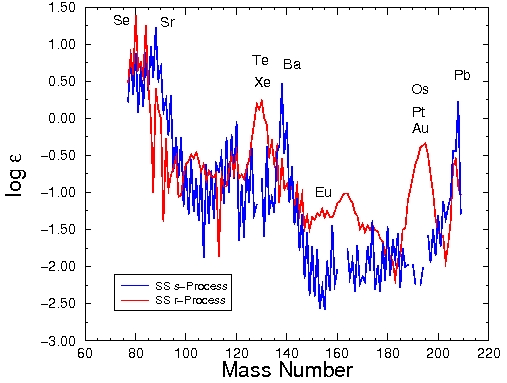
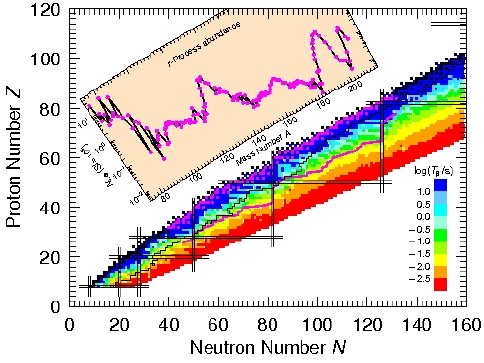
NEW FIGURES FROM ARAA (2008)
AND SNEDEN ET AL. (2009) ARTICLES:
Internet 2 :
We show in the following images how we are using the capabilities of the Internet 2.In particular we are accessing large amounts of
astronomical data that require high-speed transmission.
1. The first image shows actual stellar spectra taken with the Hubble Space Telescope, HST. (The data are transmitted from the satellite to the computers at the Space Telescope Science Institute and then sent over the Internet 2 to our computers here at OU.) The spectral lines are in the ultraviolet portion of the spectra and are not visible on the ground - only space telescopes, like the HST are capable of such observations. These observations are the first to ever detect gold (Au) in old stars, thousands of light years from earth.
HST SPECTRA OF STARS IN THE GALACTIC HALO
2. Abundance observations - note elements such as Barium (Ba), Europium (Eu), and the radioactive element Thorium (Th) - of the star CS 22892-052, which is one of the oldest stars in the universe and located approximately 6,000 light years away. The observations were obtained using both ground-based (Keck and McDonald) and Space-Based (HST) Telescopes:
ABUNDANCES IN CS 22892--052, ONE OF THE OLDEST STARS IN THE UNIVERSE
Images of galaxies taken with the Radio Telescopes of the Very Large Array (VLA) near Socorro, New Mexico:
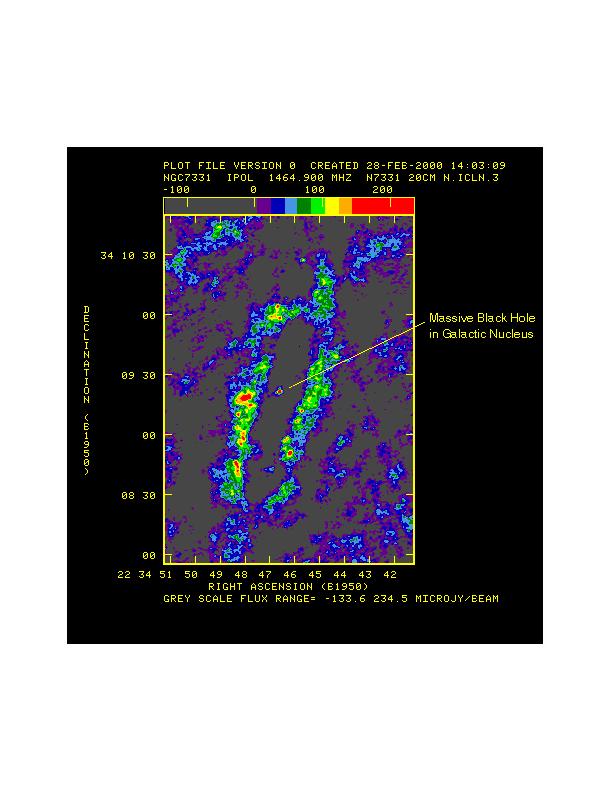
3. Galaxy NGC 7331, located approximately 30 million light
years away, appears to contain a
Massive Black Hole. This black hole was detected by researchers here
at OU (see ``Discovery of a Nuclear X-ray
Source in NGC 7331:'') A GALAXY
WITH A MASSIVE BLACK HOLE
-- A GALAXY
WITH A MASSIVE BLACK HOLE (jpeg format)
4. Galaxy M83, located approximately 20 million light years away, contains
a number of exploding stars
known as supernovae. These include supernovae 1957D, 1950B and 1923A
still radiating in the radio,
and detected by OU researchers, almost 80 years after it exploded.
A GALAXY
WITH A NUMBER OF SUPERNOVAE OR EXPLODING STARS
X-Ray Images of External Galaxies:
An XMM image of a massive black hole in an AGNBiographical Information:
MY RESEARCH INTERESTS: A BRIEF DESCRIPTION
CURRICULUM VITA: PUBLICATIONS, ETC.
MY ACTIVITIES AT THE UNIVERSITY OF OKLAHOMA: TEACHING, ADVISING, ETC.
Astronomical Data:
Radio FITS DATA 6 CM FITS file for G25.5.
Radio FITS DATA 20 CM FITS file for M83.
Radio FITS DATA 20 CM FITS file for NGC 7331.
Radio FITS DATA 6 CM FITS file for NGC 7331.
Assorted Pictures:
London (2007) at the Conference on Outstanding Questions for the Standard Cosmological Model
The boys at CES in Vegas (Venetian)
Linda's trip to Bellagio in 2006
Mom and Meg and Family pictures
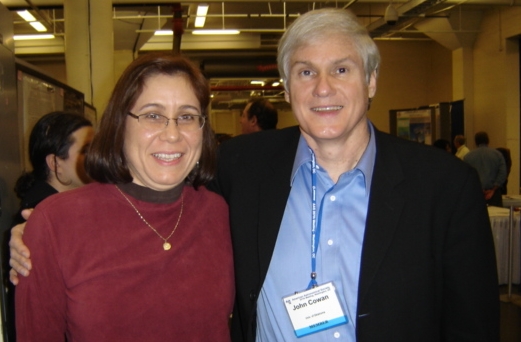
Carmen Pantoja and JC at the Washington AAS meeting in January of 2006

OU HLD Physics and Astronomy Dept. Retirement Party
THE LIFE OF MY WONDERFUL WIFE, LINDA, IN PICTURES
Last Updated 09/25/14
Number of visitors to this page: