Introduction
In conventional photoassociation (PA) spectroscopy, (1) two atoms in a trapped, ultracold gas collide with relative kinetic energy E (Fig. 1.). (2) The atoms absorb photon of energy EPA from a laser. (3) The atoms form diatomic molecules with energy Eex.
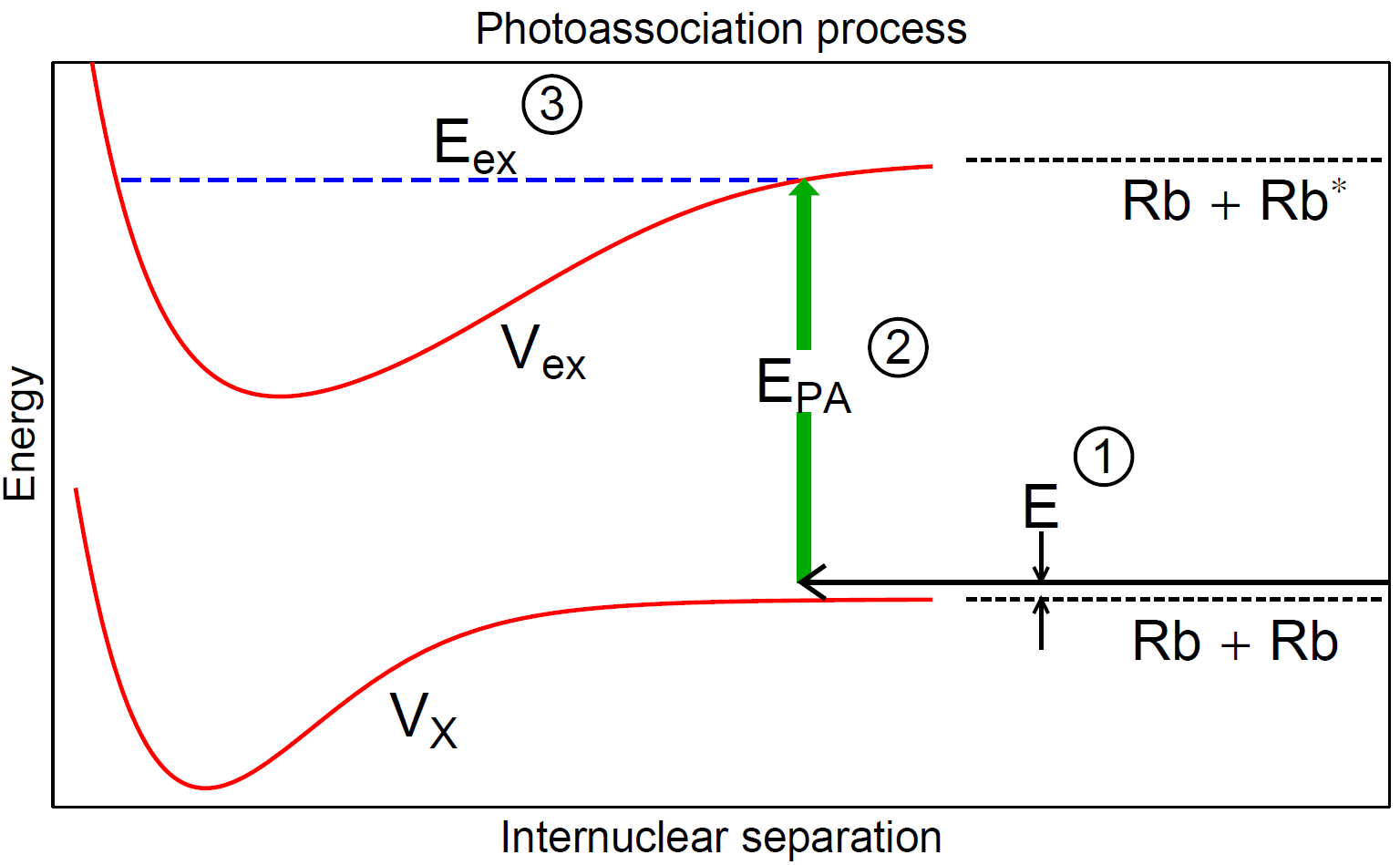
The Eex cannot be measured if the PA rate (number of molecules formed per unit time) is too small, where the rate is proportional to the overlap of the scattering wave function of atoms and bound wave function of molecule.
We use a Feshbach resonance to increase the PA rate by increasing the amplitude of the scattering wave function. This technique has been coined FOPA (Feshbach Optimized PhotoAssociation).

Trapping of Atoms
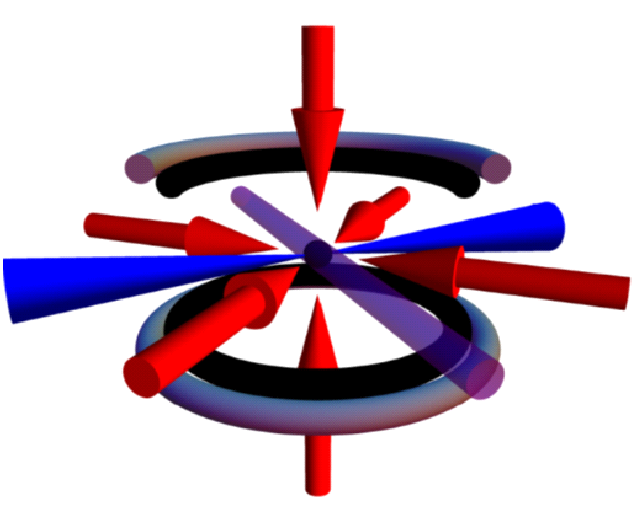
We routinely store trap roughly 5x10⁸ 85Rb atoms at a temperatures near 50 μK. We then transfer these atoms to our far-detuned optical dipole trap created by a single pass 6 W tunable Ti:S laser. This creates a trap depth of ~ 10 mK and 106 atoms/cm3 and a temperature of 200 μK.
FOPA
We choose both resonances from a previous study as well as from the forest of PA lines near the D1 transition in 85Rb. We hold the atoms in the dipole trap for a variable time between 300 and 400 ms, during which we apply a magnetic field at the Feshbach resonance found at 155 G. Below we show some initial data demonstrating the change in the density of the cloud when we are on a PA resonance and sweep the magnetic field across the Feshbach resonance.

Permanent Magnet Zeeman Slower
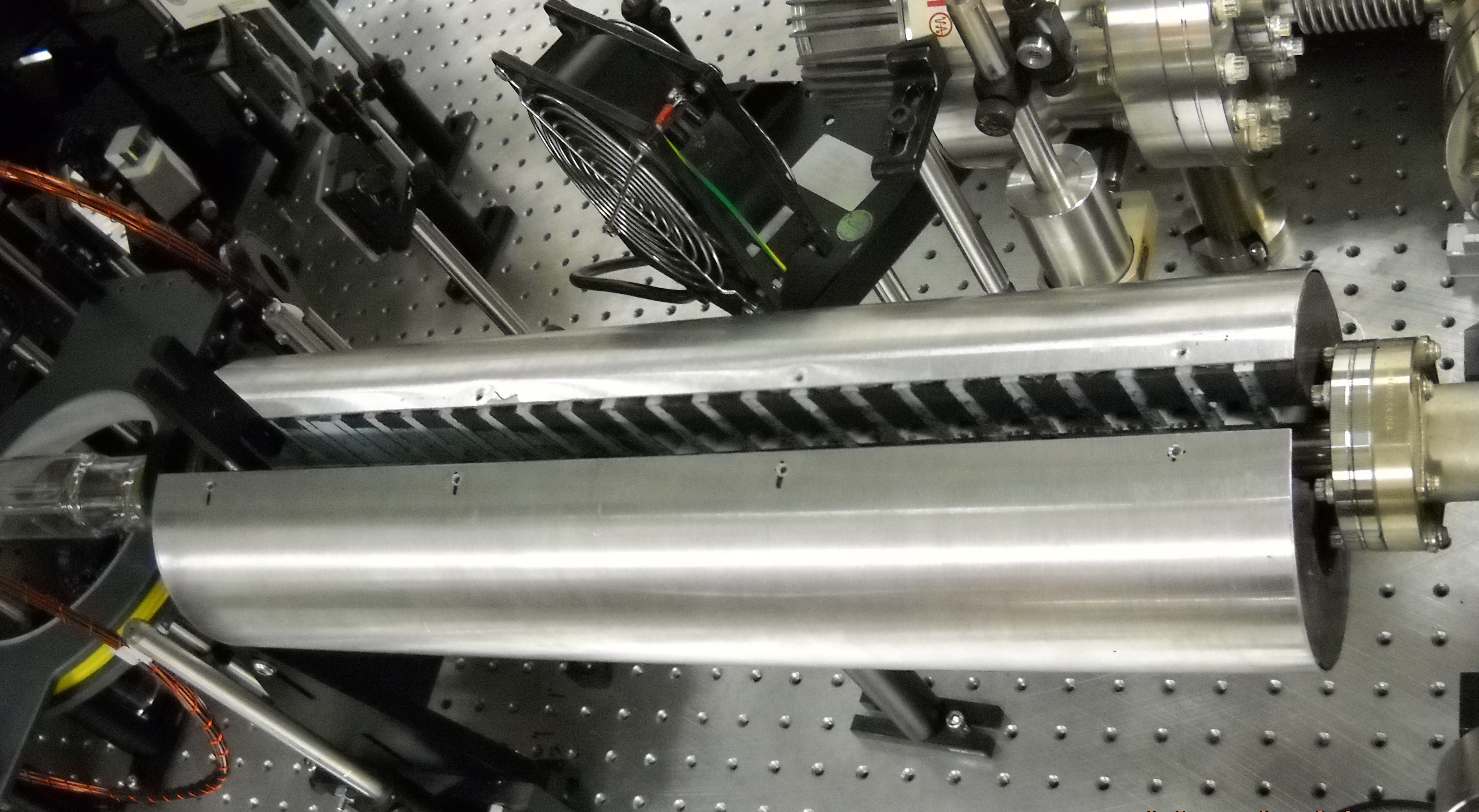
We have created a prototype zero-crossing permanent magnet Zeeman slower using flexible permanent magnets. The design is inexpensive, requires no power or cooling, and can be easily attached and removed for vacuum maintenance. Below you can find a zip file containing the notebook used to design the slower. It contains all the necessary code to create a zero-crossing magnetic field profile, calculate the necessary radii of the permanent magnets, and simulate the fate of atoms in the Zeeman slower from an efffusive source.