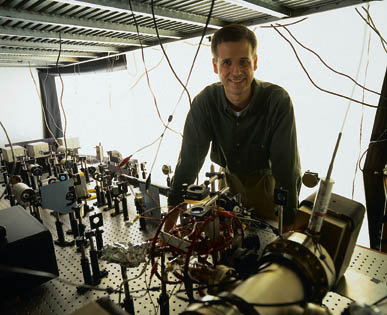
The goal of our research program is to investigate Bose-Einstein
condensation of atomic gases, to develop new atom interferometric
techniques, to create more accurate and precise atomic clocks, and to
trap and study ultracold molecules. We use a variety of lasers and
magnetic fields that can cool atoms to a range of temperatures colder
than anything else in the known universe (between 10 nanoKelvin and 100
microKelvin.) At these temperatures, the wave-like nature of atoms is
enhanced allowing studies of the exotic, quantum-mechanical nature of
matter.
Over 70 years ago, Albert Einstein predicted that a gas of
non-interacting particles could undergo a phase transition, collecting a
macroscopic number of particles into the same quantum state. The gas
must be cooled to where the de Broglie wavelengths of the individual
atoms overlap. This concept of Bose-Einstein condensation has since
been an integral part of the understanding of strongly interacting
systems such as superfluids and superconductors. However, BEC in dilute
atomic gasses more accurately approximates Einstein's original
prediction for non-interacting particles.
Another area of investigation with practical applications is to improve
current atomic clocks. Atomic clocks are important to a wide range of
scientific research (astronomy and tests of general relativity) as well
as commercial and governmental applications (communications, global
positioning systems, and deep space navigation.) While laser cooling
and trapping techniques have produced a revolution in atomic physics, it
is limited to a few atoms. We hope to extend ultracold trapping
techniques to molecules.
This work is a solid combination of both optical and atomic physics. We
use semi-conductor diode lasers with the latest in optic, fiber optic,
acoustic-optic and electro-optic technology. The experiments use
Rubidium atoms and take place in ultra-high vacuum at pressures as low
as 10^{-11} Torr, and utillize state-of-the-art, as well as home-built,
microwave, rf, and DC electronics.

 |
Disclaimer |
Contact Us |
©1993-2006 Homer L. Dodge Department of Physics and Astronomy, The University of Oklahoma
|
Disclaimer |
Contact Us |
©1993-2006 Homer L. Dodge Department of Physics and Astronomy, The University of Oklahoma